A client of mine once described their mind as a fireworks display that never stopped with new ideas arriving constantly. The client was never short on inspiration, but they struggled to finish things.
This problem often has three separate parts. First, there may be too many ideas to choose from, and no reliable way to tell which one matters. Second, even when something does seem to matter, it can be hard to hold onto that sense of importance long enough to make a real plan. And third, even after a plan happens, actually doing the thing against the pull of overwhelm and distraction, may feel impossible.
Many often consider this to be one problem: a lack of focus, or a lack of willpower. However, it became clear to me and many clients that there were actually four, distinct transitions, each of which could succeed or fail independently of the others. Understanding those transitions, and giving each one its own kind of support, changed the way I saw things.
A client can be remarkably good at generating ideas and still be unable to choose one. A client can choose an idea and even write a detailed plan for it and still be unable to act on that plan. Treating these as one undifferentiated skill obscures exactly where a given client is actually getting stuck, and it tends to produce generic advice that does not address the real bottleneck and reinforces a kind of mental fascism that only adds fire to internal negative critical voices.
Four Movements
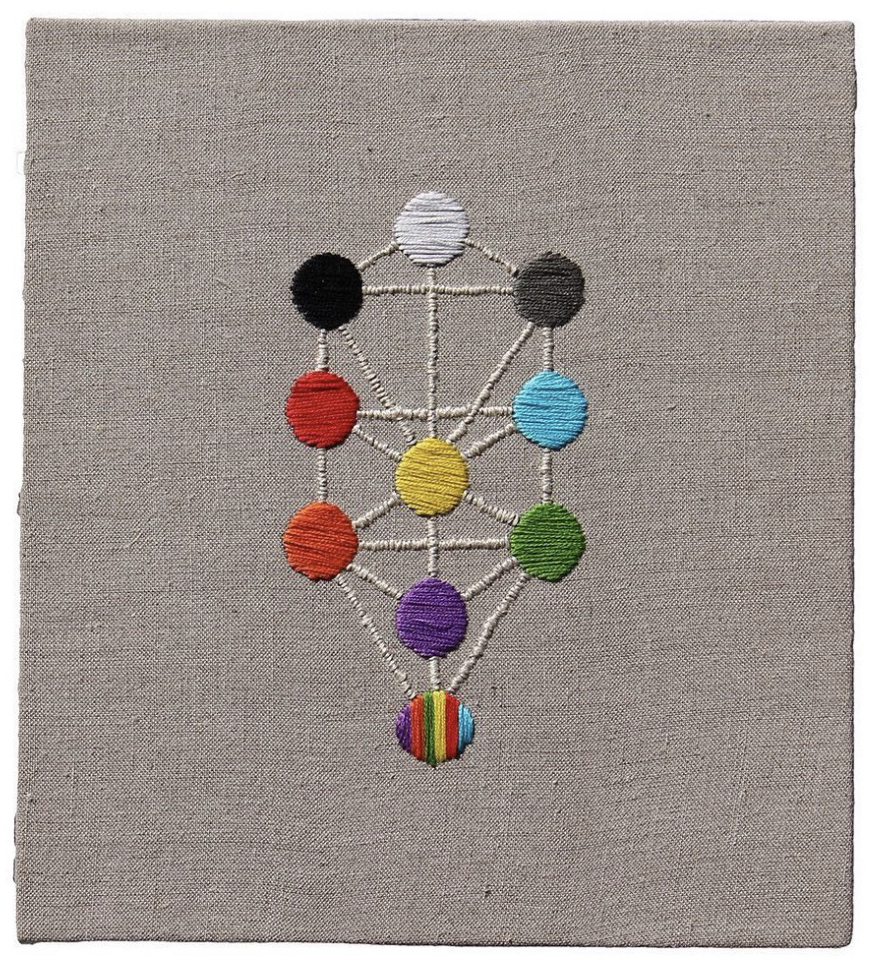
One way I have found useful, both personally and clinically, borrows, perhaps unconventionally, from the Western esoteric interpretation of the Qabalistic Tree of Life (Gray, 1997), a Qabalistic diagram that has been reworked by centuries of thinkers, from ancient Judaism to Renaissance Christian Cabalists through the Hermetic orders of the nineteenth and twentieth centuries, into a distinct tradition of its own. This is not an attempt to represent Jewish religious Kabbalah, and I am not Jewish myself. What follows draws on a Western esoteric branch that has its own several hundred year history, and I offer it here as one useful secular tool among many possible options, not as a system anyone needs to be of a specific religion or even particularly spiritual for it to be useful.
The bottom four points on the tree of life map describe, with unusual precision, the four movements the client was describing: a flood of raw material, a settling into one workable shape, the naming and structuring of that shape into language and plan, and finally the embodied, ongoing act of carrying it out in the world. In the language of the tree, these are Netzach, Yesod, Hod, and Malkuth. You do not need the vocabulary to use the structure, and I will translate each step into plain language as we go.
The steps that follow could be meditations done at separate moments, or combined into one longer meditation depending on the individual’s patience level at the beginning of the process.
Stage One: Netzach, the Flood of Ideas
Netzach is the point on the tree associated with feeling, desire, instinct, and raw generative force. For the client, this is the fireworks display itself: constant, energetic, undirected. It is worth saying clearly that this flood is not a flaw that can be trained out of a client. It is a real resource, often the very thing that makes a client creative, perceptive, and alive to possibility.
Before any of the later stages become possible, there needs to be enough nervous system safety for a client to be with that flood without either being swept away by it or shutting it down entirely. This is often the actual issue in ADHD, not attention in the abstract but the capacity to stay present with an activated state long enough to work with it. Short, body anchored practices, tracking breath or physical sensation, can help build that capacity gradually (meditation and mindfulness).
Stage Two: Yesod, Letting One Idea Take Shape
The traditional flow of stations on the tree moves from Netzach (creative spark) to Hod (structure / follow through). The path between the two stations is often depicted in the western esoteric structure of the tree by the tarot image of the blasted tower. This to me illustrates how even ancient thinkers knew how violent the clash between the spark of creativity and structural follow through can be for some minds. Therefore, we need a space to stop and reflect, which is conveniently provided on the tree as Yesod. Yesod sits below Netzach and Hod as the point where raw material first takes on a stable outline, before it can be translated into words. In the western esoteric qabalistic interpretation of the tree this station can be described as the astral mental plane or simply the realm of the mind (Regardie, 2001),(Gray, 1997).
In Jung’s framework of active imagination, this is precisely the territory being worked: a client is invited to let an image, a character, or a scene arise on its own terms in their mind, and then to stay with it, without immediately explaining, judging or interpreting what it means. James Hillman, writing in the tradition Jung began, argued that mental images have a kind of autonomy, and that psychological work goes wrong when it rushes to reduce an image to a concept before the image has been allowed to fully be itself (Hillman, 1975). That argument maps directly onto what many clients needed. The client did not need another idea. They needed one idea to be allowed to hold still and fully develop.
This looks like asking a client, once something in the flood has caught their attention, to stay with it rather than immediately explaining why it matters. If this idea had a shape, what would it look like? What does it want? What is around it? The goal is not analysis, but it is letting the idea develop enough internal coherence that it becomes something real and specific. I find with myself and many clients that resisting the pull to explain the idea immediately is what gives the idea time to become genuinely theirs rather than a concept that is quickly abandoned.
Stage Three: Hod, Structure
Once an idea has settled it is time to move into Hod, the point on the tree associated with intellect, language, and structure. This is where the actual plan gets time and mental space to develop: what will be done, in what order, by when. Here it is important to remove pressure or expectation. Just gradually fantasize how such an idea could be done, without dread (Remember mental fascism, crushing internal criticism, gets us nowhere and shuts things down).
The critical point is that the client discovers their own naming in their own time rather than receiving an interpretation handed to them. This matters for any client, but it matters especially for clients dealing with ADHD, who have spent years being told what their experience means. A plan that the client names themselves, in a way that is not pressured, built on an idea that was allowed to settle rather than one imposed from outside, tends to have a different quality of ownership than a plan a clinician simply hands over.
Stage Four: Malkuth, Bringing it to the Body
Malkuth is the final point on the tree, the plane of physical, embodied reality (The world of matter / Earth), where everything that has moved through the earlier stages finally becomes concrete action in the world. This is where the client’s third and hardest struggle actually lives: the day to day work of carrying a plan out against the pull of overwhelm, distraction, negative critical voices, and fatigue.
What helps here tends to be body based supports for sustaining action, direct work on finding a connection to view the task as interesting or joyful, work on tolerating the discomfort that comes with doing something difficult over time rather than in one motivated burst (This is another way we mitigate the violent clash between creativity and structure the blasted tower image imagery suggested above in stage two).
Body based supports might include working while standing or pacing, keeping a hand busy with a fidget toy, body doubling, or building in short, timed movement breaks so the body is not asked to sit still through the discomfort of sustained attention. Tolerating the discomfort itself is one of the purposes of this plan and of mindfulness in general, practicing staying with the restlessness or boredom for short, deliberately increasing stretches of time, the way one might build tolerance for any uncomfortable sensation, rather than treating every urge to quit or switch tasks as a sign that something has gone wrong. It is a balancing act between self mercy and self severity. Accommodation without boundaries tends to become endless avoidance dressed up as self care. Boundaries without accommodations tend to become a discipline the body pushes against and can’t sustain (the blasted tower). Follow through, in practice, lives in the balance of the two, not in choosing one over the other.
The Full Crossing Is a Skill and a Practice
Put together, the sequence runs: flood, settle, name, enact. Netzach to Yesod to Hod to Malkuth. Taking utmost care not to suppress the flood of Netzach in favor of the discipline of Hod and Malkuth. The goal is to practice the crossing itself without self judgement, as a repeatable skill, so that a client can move through all four stages with more agency each time, rather than getting stuck at any single point. This is a practice.
For a client, this can eventually mean learning to notice the flood without panic, to let one idea settle before rushing to explain it, to taking time to slowly develop the plan in the client’s own words rather than a template handed down, and to build concrete daily support for actually doing it. None of the four stages are optional. Each one if rushed can be a place where clients get stuck.
A Note on the Framework
For some clients, a spatial, image based symbolic system like the tree of life may give shape and memorability to a process that can otherwise feel abstract and overwhelming. It is an accessibility layer, not a replacement for the underlying clinical work.
If the esoteric language does not resonate with you, it can be dropped entirely without losing anything essential. Flood, settle, name, enact works perfectly well on its own.
I came to the tree early in my life as a way to give some structure to my meditation and to help me understand creativity. It is uncanny in providing a type of ladder up to quiet the mind and down to bring ideas into the real world. It gives meditation a destination and a specific quality of attention to cultivate, rather than leaving the practitioner with only an undirected instruction to “clear the mind” or “be present.”. The tree is essentially a map of different modes of consciousness a person can deliberately practice moving between, with meditation as the vehicle for learning to enter each one on purpose rather than only encountering them involuntarily.
References:
Gray, W. G. (1997). Qabalistic concepts: Living the tree. Weiser Books.
Hillman, J. (1975). Re-visioning psychology. Harper & Row.
Regardie, I. (2001). The tree of life: An illustrated study in magic (C. Cicero & S. T. Cicero, Eds.). Llewellyn Publications. (Original work published 1932)